Referencing:

February 13, 2009

Ben Shahn — The Shape of Content

Peter Greenaway — Vertical Features Remake

Anne Carson — Fragments of Sappho

David Abrams — The Spell of the Sensuous (Husserl / Merleau-Ponty)

Gilles Deleuze — Deserted Islands

Annie Dillard — Pilgrim at Tinker Creek

My own Journals 

Gerhard Richter

Luc Tuymans

Majorie Perloff – Radical Artifice

Jules de Balincourt

Lynne Drexler

Ted Ames


Deleuze — Deserted Islands — focus on Originary Islands

February 13, 2009

There are two different types of islands.  Originary and Continental.  Continental islands have drifted away from a continent or main land, and originary islands have punched up through the ocean ( The constructive nature of a growing coral reef or compiled and consolidated mass of sediments.)

All islands are considered deserted as a philosophical view (see deleuze) even if they are inhabited by humans and other species.  In the most ideal philosophical thought, humans can only inhabit deserted islands if they are sufficient and absolute creators.  

Humans which come to live on islands, in turn, give islands a “dynamic image of itself” by becoming a consciousness to the movement which produced the island (continental or originary).  THrough human inhabitants, islands become conscious of themselves as deserted and unpeopled, which we as humans know is not a reality but is still a valid consciousness of an island.  (an island, in western thought, being an inanimate object and therefore unable to posess a consciousness only granted to animate life.)  looking at indigenous cultures and non-western traditional thought one begins to uncover this understanding of land is inaccurate and a production of capitalism.  the island does have a consciousness produced by a movement.  the people are not the islands reality and are seemingly only a dream since islands believe they are deserted and unable to sustain people in a … sense.  thereofre, making of the island is only the dream of humans and a pure consciousness of the island.  this can be concluded when one reduces themselves to the movement which brought them to a place (an island).  

humans on islands can do the opposite of what the island did.  they can create on one that has drifted away and they can drift towards one that is originary.  

(the human can move in the opposite way the island did exist in their place.  a human may drift to an originary island and an island which in western thought, makes not sense of having a consciousness.)

“human beings live there already, but uncommon humans, they are absolutely separate, absolute creators, in short, an idea of humanity, a prototype, a man who would almost be a god, a woman who would be a goddess, a great Amnesiac, a Pure Artist, a consciousness of Earth and ocean, an enormous hurricane, a beautiful witch, a statue from the Easter Islands.  There you have a human being who precedes itself, insofar as it imagines and reflects itself in its first movement.”

“It is not enough that everything begin, everything must begin again once the cycle of possible combinations has come to a completion.  The second moment does not succeed the first: it is the reappearance of the first when the cycle of the other moments has been completed.  The second origin is thus more essential than the first, since it gives us the law of repetition, the law of the series, whose first origin gave us only moments.  But this theme, even more than in our fantasies, finds expression in every mythology.” p.13

“In the ideal of beginning a new there is something that precedes the beginning itself…” p.14


(moved to be still)

February 13, 2009

2.8.09

Minutes

I Sylus conversation / movement to stillness (O is the voices moving until they are moved to be still)

Chatter, language, translation, understanding, communication, coersion, relaxation, comfort, reassurance, repetition, song.

Hours

O Rubbings / stillness (O is still)

Sticks, ice, bark, buds, grass, ground, stones, leaves, nettles.

I Sketching / stillness (O is sleeping)

Sleep, comfort, coziness, children, lovers, dream.

O Plein air / movement (O is moving)

Ocean, tides, rocks, algae, coast, foam, waves, sky, horizon, islands, submerged, breaking, emerging.

Days

O Spray paint + masking / movement (I am moving and O is moving)

Trees, roads, hills, bushes, branches, piles, sky

O Drawing / movement (O is moving)

I Drawing / stillness (O is a photograph)

Landscape, Cole, stopped, moment, trees, sunlight, dirt, leaves, shadow, depth, Peaks Island, preservation, documentation

Weeks

O Place painting / movement (I move and O moves)

Peaks Island, beach, beaver dams, woods, the edge

I Nights / stillness (O looks still through my window)

Layering, subtleties, trees, shadows, light, shifts

I Blocks / movement (My memory moves O in my memory)

Layering, shapes, through, over, above, inside, around, in between, all over, through out, emerge, re-emerge, come together.

Months

I Month Painting / movement (My mind moves for O to show itself)

Layers, mix, window, searching, pattern, one, inspired, spontaneous, planned, square, in, circles, stop, dry, start, remove, obscure, add, next, again, mask.

Seasons

Warm

(O is moving)

(I am moving and O is moving)

(O is moving)

(I move and O moves)

(My memory moves O in my memory)

(My mind moves for O to show itself)

Cold

(O is still)

(O is sleeping)

(O is a photograph)

(O looks still through my window)

(My memory moves O in my memory)

(My mind moves for O to show itself)

Years

I Conversation about Sy.

“…” indicates more to come

O is The Outside and The Object

I is The Inside


David Abrams – The Spell of the Sensuous

February 13, 2009

Yet we should not be so ready to interpret these dimensions as “supernatural,” nor to view them as realms entirely “internal” to the personal psyche of the practitioner.  For it is likely that the “innerworld” of our western psychological experience, like the supernatural heaven of christian belief, originates in the loss of our ancestral reciprocity with the animate earth.  When the animate powers that surround us are suddenly construed as having less significance than ourselves, when the generative earth is abruptly defined as a determinate object devoid of its own sensations and feelings, then the sense of a wild and multiplicitous otherness (in relation to which human existence has oriented itself) must migrate, either into a supersensory heaven beyond the natural world, or else into the human skull itself — the only allowable refuge in this world for what is ineffable and unfathomable.  p 10 

remain transparent 

Magic, then, in its perhaps most primordial sense, is the experience of existing in a world made up of multiple intelligences, the intuition that every form one perceives — from the swallow swooping overhead to the fly on a blade of grass, and indeed the blade of grass itself — is an experiencing form, an entity with its own predilections and sensations, albeit sensations that are very different from our own p 9-10

paint primordial senses and multiple intelligences.  every form painted is one experienced.  

painted directly or from memory of experience.

The traditional magician cultivates and ability to shift out of her common state of consciousness precisely in order to make contact with the other organic forms of sensitivity and awareness with which human existence is entwined.  only by temporarily shedding the accepted perceptual logic of his culture can the sorcerer hope to enter into relation with other species on their own terms; only by altering the common organization of this senses will he be able tot enter into a rapport with the multiple non-human sensibilities that animate the local landscape.  it is this, we might say, that defines a shaman: the ability to readily slip out of the perceptual boundaries that demarcate his or her particular culture — boundaries reinforced by social customs, taboos, and most importantly, the common speech or language — in order to make contact with, and learn from, the other powers in the land.  His magic is precisely this heightened receptivity to the meaningful solicitations — songs, cries, gestures — of the larger, more than-human field. p 9


Anne Carson — Fragments of Sappho

January 28, 2009

It is partly what is missing in the poems, what we don’t know, to which we bring our own desires and interpretations, that enhances its erotic spell.  

In the fragments of just a single line, the words assume a particular, devastating power. [you burn me]

By bringing her particular kind of austerity to the translation, Ms. Carson has deepened Sappho’s mystery and yet brought us closer to her

Sappho’s poetry is filled with a golden eroticism. It is redolent of Attic sunshine, the sweet smells of the Aegean, Grecian meadows.

It is an eroticism from an ancient time when lines between homosexuality and heterosexuality were blurred, before distinctions were made and fear and prohibitions came into place.

It is said that Sappho died for love of a younger man, Phaon, a ferry boat captain, that she threw herself off a cliff because of him.

But that is probably a lie.

nytimes


NYC 1.21-1.25 2009

January 23, 2009

Petia’s visualization class

The MET – Rubens, Ruisdal, Turner, 

The Cloisters – cloaks, head dress

John Cage Lecture on Nothing

Content is poetry.  Poetry is a creative act which uses language.  My paintings are a language interpreted through the landscape by looking.(i.)structured in a system of painting (ii) the context (landscape) where the marks are inspired from (pragmatics) and (iii) dependent on their context the content specifity, i.e. its meaning (semantics).Petia’s visualization class


Here we are now at the beginning of the fourth large part of this talk.  More and more I have the feeling that we are getting nowhere.  Slowly, as the talk goes on, we are getting nowhere and that is a pleasure.  It is not irritating to be where one is.  It is only irritating to think one would like to be somewhere else.  Here we are now, a little bit after the beginning of the fourth large part of this talk.  More and more we have the feeling that I am getting nowhere.  Slowly, as the talk goes on, slowly, we have the feeling we are getting nowhere.  That is a pleasure which will continue.  If we are irritated, it is not a pleasure.  Nothing is not a pleasure if one is irritated, but suddenly, it is a pleasure, and then more and more it is not irritating (and then more and more and slowly).  Originally we were nowhere; and now, again, we are having the pleasure of being slowly nowhere.  If anybody is sleepy, let him go to sleep.  John cage  


Reasoning About Control: An Evidential Approach

January 2, 2009

Reasoning About Control: An Evidential Approach Authors: Leonard P. Wesley; John D. Lowrance; Thomas D. Garvey; SRI INTERNATIONAL MENLO PARK CA ARTIFICIAL INTELLIGENCE CENTER

Abstract: Expert systems that operate in complex domains are continually confronted with the problem of deciding what to do next. Being able to reach a decision requires, in part, having the capacity to “reason” about a set of alternative actions. It has been argued that expert systems must reason from evidential information — i.e., uncertain, incompletes, and occasionally inaccurate information. As a consequence, a model for reasoning about control must be capable of performing several tasks: to combine the evidential information that is generically distinct and from disparate sources; to overcome minor inaccuracies in the evidential information that is needed to reach a decision; to reason about what additional evidential information is required; to explain the actions taken (based on such information) by the system. These are a few of the formidable control problems that remain largely unsolved. If expert systems are to improve their performance significantly, they must utilize increasingly sophisticated and general models for dealing with the evidential information required for reasoning about their behavior. To this end we present an alternative, evidentially-based approach to reasoning about control that has several advantages over existing techniques. It enables us to reason from limited and imperfect information; to partition bodies of meta- and domain- knowledge into modular components; and to order potential actions flexibly by allowing any number of constraints (i.e., control strategies) to be imposed over a set of alternative actions. Furthermore, because it can be used for reasoning about the expenditure of additional resources to obtain the evidential information needed as a basis for choosing among alternatives, this approach can be employed recursively.


? Title ?

January 2, 2009

Liberating the Ineffable and Unfathomable

Painting: A Refuge For the Ineffable.

Painting: An essential nutrient to the preservation of a significant ecology cultivating reciprocity and knowledge of a temporally wild and multiplicitous otherness.  

A True Justified Belief in Painting:  

Painting’s Use as Technology: Qualitatively Collecting and Producing Evidential Knowledge of a Landscape.

Integrating Evidential and Non-Evidential Information To Have A More Attuned System of Knowledge.

A Technology to Organize the Knowledge of an Inner and Outer Landscape

[evidential reasoning, evidential information]

evidential information – i.e., information that is to some degree uncertain, imprecise, and occasionally inaccurate.

The information technology (IT) of painting applied to the landscape for knowledge management (KM).

the range of information technologies are said to capture, store, retrieve, transfer and apply knowledge. Action research, with its emphasis on praxis and on the importance of ‘situated, practical theory,’ is an ideal vehicle for deepening PAINTING’s field of understanding of the design of experiments  Knowledge Management Systems for use in with the landscape / inside or outside the studio.  


= Virgo and Pisces =

January 2, 2009

“The South Node in Virgo represents a Virgoan bias toward empirical means of gaining knowledge, and a resistance to the Piscean intuitive, numinous, consciousness-expanding tools for knowing.” lisa dale miller

“Virgo rules the body; Pisces rules the transcendent mind and deep psyche. Virgo is classical physics; Pisces is quantum physics. Virgo is healing the body with medicine, surgery, healthy lifestyle habits, and diet; Pisces is healing the individual and collective soul or psyche through energy medicine or the development of consciousness itself. Virgo is engineering and technological advancement through research and development; Pisces is the flashing, intuitive brilliance of revelation and abstract mathematics. Bring together the Virgo/Pisces duality—the mind/body connection—and you get the total spectrum of inner and outer knowledge. Mistakes are made when how we gain knowledge arises from a need to unnecessarily favor one to the exclusion of the other.” lisa dale miller


For more to follow and fall in line:

December 28, 2008

Retrospection

Resonance

Patterning

Islands – originary 

Cartographic

Autoethnographic/Ethnographic/Anthropology

Multiple Perspectives

Poetic

Itinerant (in context of others)

Cosmologies

Magic/Shamanism/The Ineffable 

Art Brut/Outsider Art vs. Institutionalized

seeking new (as yet unfound) solutions/utilities for research and technology

engineer (work with what you got)

augmented vision vs. native sight capacity (contacts, glasses, night vision goggles)

a lie vs. a truth

texture vs. flatness

qualitative vs. quantitative

inside vs. outside

hyper-detail vs. abstract

devoid of humanness vs. humanness

figuration vs. abstraction

RHODE ISLAND

GRAFFITI

ORGANIZED ORGANIC (MATTER)

TECHNO-NATURAL

COMMUNICATIVE-PAINTING TECHNOLOGY

technology is not merely the result of scientific research.  

Bernard Stiegler, in Technics and Time, 1, defines technology in two ways: as “the pursuit of life by means other than life”, and as “organized inorganic matter.”[


Experiments

December 28, 2008

These experiments are to be completed in January 2009.  

They are to probe and question, in observing the landscape, the propensity quantitative information has to  to be observed/translated/represented in a qualitative way.  By using painting as a technology in itself, these experiments are designed to re-inject methods and conclusions — producing a techno-natural set of data about the landscape — back into the painting process.  

1.    Night Vision Drawing/Painting

Go outside at night.  Set up drawing station or painting station with a flashlight.  Then put on night vision goggles.  Make ten small charcoal drawings/paintings.  Note how depth perception is effected by infrared light and the use of one lens instead of two.  Is it hard to look at things in close proximity to the goggles?  Can you see further with the goggles on? Analyze shapes

2.  Night Paintings

Make paintings at night using your own faculties of sight and whatever light there is available (moon, streetlights, houselights etc…)

3.   Diagramming Landscape

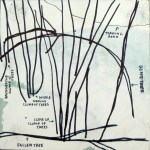
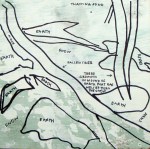
-Sharpie landscape drawings over paintings of Peaks Island, ME and Center Harbor, NH are respectively and distinctly labeled within contours of shapes.  These shapes include SNOW BANK, TREE, SKY, ROAD, ROCK, and PILE OF LEAVES etc. The words are labeled haphazardly so that the shape of the SKY is has the potential to become what we assume is the road until we get close enough to see a label that indicates otherwise.  The diagrams challenge our categorization of generic landscape shapes.

-2nd iteration: rubbings/ with charcoal, textures of things outside (bark, branches, twigs, ice, buds, nettles, dirt etc.) direct vocabulary created through a visual reference to texture instead of a label on a painting.


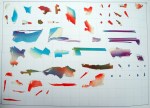
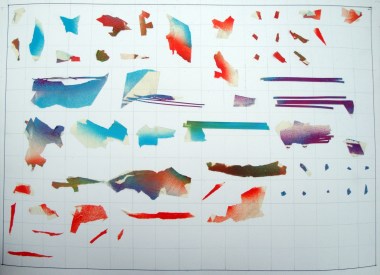
Continue the process already designed to make multiple paintings with multiple perspectives in sharpie marker, spray paint and masking tape.  Change the process to include a large piece of paper gridded off into squares so that the pieces of used masking tape can be placed respectively in each of the squares after being spray painted and removed from the paintings.  

4.  Pedometer/Heart Rate Monitor

Measure the amount of steps it takes to do daily activities.  

Measure the amount of steps i take in taking a walk through the woods.  Measure my heart rate while taking that walk.  diagram and then make a painting illustrating the experience abstractly based on the information gathered by the pedometer and heart rate monitor.  

5.  Paint By Month

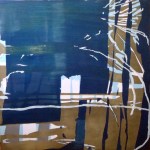
-This experiment aims to push myself to develop a practice for larger landscape paintings, which synthesize the different painting styles I have explored in the past year and a half.  There will be four paintings each 36”x 36”.  One will be completed every month and be titled as such.  Four colors of spray paint (along with other painting materials) will be used each month with one can changed out as time progresses.  Each month I will note other practices I use to complete the paintings i.e. memories, stencils, photographs etc.

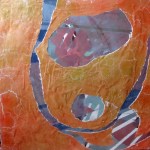
2nd iteration: Layering multiple perspectives of the land on Peaks Island as seen from walking, memories of walks, objects gathered on walks and looking out my window.  I began to use plaster as a new material because I could not get the paint thick enough on the large canvas to add textural contrast.  


January 2009

January

February

February


6.  Monitoring Masking Tape / (Organizing Organic Masking Tape(Matter))masking_grid_12092

7.   I s Land Tags

Take spray paint and tag out on a walk(s).  Find a rock/wall/cement area that could be used to create a scene in masking tape inspired by where you are standing and what you see.  Spray paint the negative space.  Photograph the shapes created in the environment they now exist. Note how they are affected by their surroundings or how the marks themselves affect the environment.  Using a map, mark where you have put this mark/tag.  Recreate a map using only the new marks created in the landscape as guidelines for how to travel through the space in between these marks.

2nd iteration: Map out 5-10 different places to make a painting on the island.  Title each place.  (Beaver dam, centennial beach, ferry dock, john trot park etc.)  Bring a large canvas to be added to at each spot to layer each place.  Also, create a small spray painted/sharpie painting at each spot.  In the end I will have various images on different small paintings (titled with corresponding place made) and one image created by layering a single interpretation of each place on one painting. (Titled with the accumulation of place titles) possible poem could emerge also.

8.  Drawing from Photography

-Draw a Peaks Island landscape from a photograph to create a relationship between abstract and representational landscapes. Also interest in drawing something still (not alive or moving)

2nd iteration: draw large and on site (40”x50”) interested in drawing from life the different experience of being outside on site drawing instead of painting.  Also representational.

9. Putting Sylus to Sleep

-Qualitatively describes the quantity of time it takes Sylus Caswell to fall asleep. Six tracks recorded in Garage Band and compiled on a CD of pre-midday nap lullabies. Each track is titled by date.  The length of the tracks vary from seven to ten minutes while the quality of each remains constant as to deliver comfort and safety in repetition and tradition.

-2nd iteration: Recording in garage band the quality of the quantity of time it takes Sy to fall asleep.  This iteration focuses on Sylus’ conversation with those in the room while he is being put down and the folding of a child’s learning language development with an adult developing their vocabulary of musical language.  The type of musical language being honed is individual notes. Therefore, there is no singing or chords being played to lull him into sleep, rather, a collection of single notes strung together in simple song and repeated.  


December 22, 2008

Thought and feeling, logic and intuition, observation and impression

balanced well

senses

touch, smell, sight, sound, taste