no. 6

February 7, 2010

BREAK THROUGH.


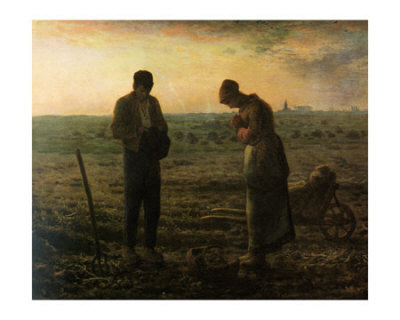
Millet – The Angelus

January 27, 2010

Rob brought up this painting last night before we all went out to see Darien Brahms play at Port City Music Hall. (She played Green Valentine for Cole)! We barely talked about the subject matter: Man and woman in a field, bent over, revering a basket. We mostly talked about how it was painted and why? Why?! Rob was interested in our thoughts on what could inform a painter to paint a particular way.  In this example with smooth, sharp, realistic execution, joined to a broken up, disparate, playful display of woven color. I am predisposed to the latter disparate way of making marks, a way of showing the world as being anything other than smooth, yet still fluid. So i quickly reacted to the replication in Rob’s art history book as beholden of valid ways of seeing the world with your own eyes.

I imagine the bottom and sides of the painting to be executed differently from the center and top because of our own eyes inability to focus on the periphery. The sharpness falls on our focus, our subject, the people we are looking at. The surrounding areas inevitably fall off and are recreated in pieces because they are not the focus of light or of our vision, but are still being molded into appearing by the light. I went all the way to say that painting something in a situation that is more direct to the actual light source depicted in your painting makes it a better painting. I know, i say things like this in very limited company, and then write down the word “better” here. Don’t know if i really want to say that, but lets just put it our there, and now talk about what Rob brought this painting to our attention for.

Rob and Cole had talked about the piece briefly before, they noted The Angelus as being a painted work displaying evidence of strong influences of photography. Cole agreed with Rob that Millet was depicting a vision that was not seen before photography. They thought that the way the periphery is painted — blurry, broken up, less focused — is indicative of a camera’s ability to re-present the world. In other words, the camera begins to show things as somewhat vignetted as a lens is rounded. They speculated that Millet surely looked into a camera obscura and had access to the technologies of the day which could re-present a scene in this way. No one spoke of the painting being made FROM a photograph, simply that it had the potential to have been INFLUENCED by a photograph.

The great and complicated relationship painting has to photography still eludes me in definition. Its helpful to be a part of a conversation like this. Its helpful to remember dates and times of advancement in sight. Its helpful to talk about the medium’s respective differences and also to note when we see them coming together to create a singular vision, like we presume they are in The Angelus. Recognizing when one is exposed to technologies which help us record and re-present the world help us to understand the trajectory painting has taken to get to now. Things that have never been seen before begin to show in Millet’s example of multiple ways of seeing the world. A way that shows us the beginning of a painter’s — an artist’s — ability to make a version of the world which includes multiple perspectives, not disproportional re-presentations, but more than one way of seeing in one thing.

Either way you break it down — as a personal vision or as a way of seeing perpetuated by photography — there exists an undeniable admittance that photography did exist at the moment in time this painting was made. Chronologically reassuring us that photography was accessible.   It also reminds us that painting has a strong ability to evolve and incorporate different ways of seeing the world into itself in order to connect with a viewer. An ability to take different views and impart, coerce, weave, collect, relate, multiple impressions to show a clear singular thought and vision.


no.5

January 27, 2010

DRAG AND DROP


New Logo: The Sphinx

January 17, 2010

Oedipus and the Sphinx - Gustave Moreau

Sitting at Ozzie’s, a coffee shop on 5th ave and Garfield in Brooklyn’s Park Slope area, i came across an astrology book printed in the 70’s, but first published in 1943.  Its writing described an aspect of astrology that i began to understand a few years ago, yet had found little other writing to support a way of thinking about the zodiac.  Simply, it is an analogy of the cycle of the development of human life (from young to old, infant to elderly)  to that of the sky’s cyclical system of rotating zodiacal signs.  The western astrological cycle does not correspond to our sense of time in years with say, January being the beginning.  Instead it begins at the end of March in Aries.  In this way of understanding the zodiac, Aries is the beginning, the infant, the blank slate, the state of wonder of the world.  Pisces (which comes right before Aries) is the end, has seen it all, tried everything and understands through experience, or from innate empathy for it encompasses what has come before.
This book at Ozzie’s, Astrological Signs – The Pulse of Life by Dane Rudhyar, illustrated a striking state of the transformation of time between Leo and Virgo.  This point in the zodiac interests me as my love, partner and collaborator, Cole Caswell is a sun in the cancer-leo cusp and i am a virgo-libra. We live together on the bridge from Leo to Virgo.  Here Rudhyar describes is where:

Productive activity on the basis of strict individualism and emotional self-expression presents to man a riddle.  How can physical and nervous exhaustion, emotional tragedy and disillusionment be avoided?  In essence this is the question which man everlastingly asks of the Sphinx; and there is a fitting tradition which says that the point of the zodiac which ends the sign Leo and begins the sign Virgo carries the symbol of the Sphinx.  This mythical creature which still faces today the sands of Egypt has the body of a lion and the head of a virgin — this is indeed the meeting point of Leo and Virgo.  It symbolizes the answer to the eternal query we have just stated.  What is this answer?
The answer is two-fold; yet the two sides of it should be integrated and that integration, difficult in practice though simple in theory is the very secret of the Sphinx, which is two being in one.  One side of the answer refers to the wear and tear produced by the impulsive and stressful type of activity and its dramatic gestures.  The answer can be summed up in one word: Technique.  The other side of the picture deals with a repolarization of the emotional nature itself.  Technique and emotional repolarization are the two keys to the secret of the Sphinx.          p.70-71

I found it fitting that the symbol of the Sphinx is one that presents us with riddles and answers to the meaning of being alive.  Life, here, is composed of both animal and human parts, two perspectives Cole and I often consider in our work.  As artists, Cole and I collectively rack our brains and trudge onward wondering how to avoid and cope with “physical and nervous exhaustion, emotional tragedy and disillusionment” coming up with methods for coping and staying conscious become the crossbeams that allow our learned techniques in the visual arts to build a larger and more secure and sustainable structure where we can continue to produce work under.    With the head of the virgin and the body of a lion, i imagine an accurate representation, a well organized example of curiosity, emotion, and integration of what leo-virgos do in the time between each other.


NYC (Blue Hammer @ Issue Project Room)

January 17, 2010

no.4

January 11, 2010

CLIMB OUT OF YOUR HOLE!


Deep Pink Peach Stains

December 24, 2009


no. 3

December 16, 2009

FEEL THE CURRENT


REFINEMENTS Printed in Peaks Island Times

December 6, 2009

see the link REFINEMENTS to the left under VIEWS if you would like to read what is printed. 


First Friday Art Walk Thrives in December

December 5, 2009

First Friday, December 4, 2009 was a lively swarm of artists and art supporters up and down Congress Street on a warm Portland night.  It felt like the wondrous season of giving had actually begun (a horse drawn wagon was spotted jingling its way through the Old Port) and the warm air made everyone move easily in and out of all of the galleries and artist studios.

Three spots were of great cheer.  Our first stop, Whitney Art Works, showed a group exhibition of their members.  It was a first to see Iain Kerr‘s red, black and blue pen diagrams in person.  I had been admiring them on Etsy and now could see with greater detail their moleskin paper looking cut out of his journal with a razor blade.  Along with this nonchalant quality was their Tetris shaped display re-iterating the puzzling structural elements one sees as they stand there trying to figure out how he fit all of the words and marks together in such perfect sense and harmony.  An impossible task with the masses surrounding and wanting to get a look, but i attemepted for a few moments.

The pencil drawings of Clint Fulkerson and small pin buttons of Patrick O’Rorke also got my attention.  Simple statements in black on white backgrounds like “Ain’t No Shame in My Game” and “Don’t Thank Me, Pay Me”  were being sold for “a dollar or best offer” at the gallery desk.  From there, if you turned to the left you would see the entrance to the back room, then a collection of Stephen Benenson‘s small oil painted heads, and then Clint Fulkerson‘s drawings of sinew like cell structures perfectly rendered with the indent of hard pencil slightly outlined with a softer darker pencil.  They had the markings of a metalsmith, someone with keen attention to detail.  However, the ones I enjoyed the most were the ones with abnormalities, the pauses, a slight change in overall pattern showing that there really was a human hand at work.

We came across Stephen Beneson’s work again as many of the artists represented by the Whitney work from studio’s above SPACE Gallery and were opening their studio doors to the Art Walker’s as well.  It seemed like endless floors rising above SPACE as you wove your way in and out of a very many painting, photography, and printmaking studios while trying to say “hi” to friends and make space for fellow Art Walkers trying to see it all as well.  Being abel to see the work in The Artist Studios and standing in a small space with the artists themselves made returning back to the gallery scene on the streets below less attractive.  How often do you get to stand in someone else’s studio, look at what they’re working on, not being pressed to say anything, but having a comfortable opportunity to do so if you wish!? We withstood the mad house and made our way into as many studios as we could, ending up spending the most time with the beautiful space and drawings of Beneson, and with the intriguing paintings of Annie Godfrey Larmon who shows with Aucosisco and writes for the Portland Phoenix.

Last but not least were the street vendors sitting and standing with their wears on the fringe of the passage between Whitney and SPACE gallery.  I asked some MECA students I recognized selling drawings, copper rings, and pottery if the school promoted them doing this and they said: no one says anything, we just do it.  SMCC student, Infini-tees designer, and screen printer, Tim Othy Goldkin, stood and helped people find sizes of his designs which are printed on reclaimed shirts and laid right on the sidewalk to peruse.  One design displays a non descript figure grounded, but almost floating, traversing a city at night with PORTLAND in a whimsical bold font below.  I love that this part of the Art Walk is growing.  It gives the event a real traveling artisan feel and re-vivifies the original intent of the founders of the walk to allow the space between 5-8p on every First Friday to be one filled to the brim with what the artists of this city can offer and show us all how they make it diverse and beautiful.


Studio Day Outside in a Warm December.

December 5, 2009

no. 2

December 4, 2009

AW, SICK!


Block Island in November. Getting Re-acclimated

November 23, 2009

It has been a while now since i spent any meaningful amount of time on Block Island.

I mean, i can count on my hands the amount of times i have returned home after going off to grad school.
Once to note that who my boyfriend was, really wasn’t — and that the man i really wanted to be my boyfriend would never be. The second was to show someone i love a place that i loved. The third was to show that someone what i used to do in the place i loved. The fourth time i began to question what i truly did love about both the place and the people who lived there. The fifth i defined the parts that could remain lovable and what my new home in Maine offers that BI can not. And the sixth time Cole and I brought Parker to show him that there were many things to love on Block Island and there are many things still to be learned as I continue to re-define this place.

Our plan was to arrive mid day and begin exploring right away. We drove the car from NH to Point Judith, without a car reservation, missed the 11 am ferry and had to kill six hours in southern RI without going too far or missing our car’s stand bye position to get on the 5 pm ferry. It was dark when we finished the hour ferry ride and landed on the island. We were hungry so we met up with the one and only, John Foster, for some dinner at the Albion and Parker’s first lesson: the game of pool.

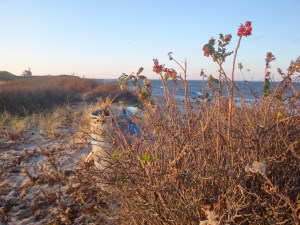
The next morning Cole and Parker discovered the Mannissee farm animals. A collection of strange and peculiar varieties of camels, sheep, mules, zebras, rams, chickens, goats… my favorite are the fainting sheep. Then we went out into the rainy morning to explore all the nooks and crannies we could get our Outback into.

Beginning at in the southeast at the Mohegan Bluffs, Parker found clay sediments and signs of geological terms like erradic and slump. We walked the steep stairs down and began our rock collecting in the clay sediments at the bottom of the bluffs. Next, we went over to the second bluffs and found the even more beautiful steep and dangerous views down to where the Mannissees supposedly starved out an invading Mohegan tribe.
Then, around the island we went. Fresh Pond, Indian Cemetery, Cooneymus Rd. Beach, West Side Quarry, over Beacon Hill, and into town for a BIG (Block Island Grocery) deli sandwich. There we ran into just who we weren’t looking for, but wanted to see – Donnie Demers!

Donnie has a practice of going every morning, before work (stripping a roof the weekend we were there) to the North Point or the Dump Beach in search of Native American Indian artifacts. He had a truck floor full and a truck bed scattered with remnants of that morning’s outing. Donnie claims his classification of his artifacts are simply “speculation and conjecture” but, theorizing about Native American Indian technologies is what we were ready for. We made a date for Saturday night, after he got done with work, to come over to his place to see and talk about his massive collection of Mannissean Indian clubs, arrow heads, hammers, scraper, and grinding tools.  We made plans to visit Donnie — at home after he was done with work the next day — to see his collection and discuss all of his findings in their entirety.

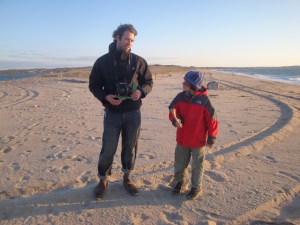
Our day continued, eating our lunch on State Beach, at the sole picnic bench stashed above high tide at the Fred Benson Pavilion. We continued north down Corn Neck Rd. to reach the Dump Beach (Donnie believes this was an area where the tools were being made).  It is widely known that the north side of the island is where the most dense settlement of Native Americans (Manisseans) lived. We spent some time here and then went to the very end and trekked out to the North Light. Both of these spots (Dump and North Light) are places i never really hung out at because they are notorious party spots and i never gave them much credit for other things. There was no evidence of any partying in either place except for a beautiful fire pit in between some dunes near the tip of the island. It was windy as hell and we chased seagulls up into a cloud above us and then stood at the very tip of the island looking out at the vastness of the ocean in every direction.

The next day we hiked some of the Greenway trails. We own the “On This Island” guide book — authored by Scott Comings and Adrian Mitchell — and Parker chose to start on the Fresh Pond Greenway trail. This trail lolled its way through some meadows and lots of low shrubs surrounding the pond. We saw a few deer and tried to get a good eye on some birds. After what was a nice bird watching, deer siting walk around the pond, we went down into Rodman’s Hollow, and up onto the bluffs heading towards Black Rock. Here we took longer to get out than we liked and P began to get tired out. We fed him and hit the trails again. This time, our final stop past the Painted Rock and down to Vail Beach.

The sounds of the water running down alongside the trail to the beach with the ocean roaring ahead was my favorite part of the trip. We spent a long while walking Vail Beach looking for things that caught our eye and making our way to a fort i knew of that we found to have been be destroyed. We went back to John Foster’s to relax before our visit with Donnie, which ended up being the highlight of Parker (and i think Cole’s) experience of Block Island in November.

Borrowed from The Book Collection of R.Lieber:

November 9, 2009

The Loom of Art
Germain Bazin (Chief Curator, Museum of the Louvre) – author.
Jonathan Griffin – translator.
Simon and Schuster. New York. 1962. 328p.


On Longing: Narratives of the Miniature, the Gigantic, the Souvenir, the Collection

Susan Stewart
Duke University Press. 1993. 232p.


The Poetics of Space

Gaston Bachelard
1958.


Sign Removal

November 9, 2009