First Single off our upcoming album, Bad Dads:
https://w.soundcloud.com/player/?url=https%3A//api.soundcloud.com/users/148649391&auto_play=false&hide_related=false&show_comments=true&show_user=true&show_reposts=false&visual=true“>
SEA LION WOMAN
Archive of Jessica Townes George
First Single off our upcoming album, Bad Dads:
https://w.soundcloud.com/player/?url=https%3A//api.soundcloud.com/users/148649391&auto_play=false&hide_related=false&show_comments=true&show_user=true&show_reposts=false&visual=true“>
SEA LION WOMAN
Everything that ever happened to me
is just hanging—crushed
and sparkling—in the air,
waiting to happen to you.
Everything that ever happened to me
happened to somebody else first.
I would give you an example
but they are all invisible.
Or off gallivanting around the globe.
Not here when I need them
now that I need them
if I ever did which I doubt.
Being particular has its problems.
In particular there is a rift through everything.
There is a rift running the length of Iceland
and so a rift runs through every family
and between families a feud.
It’s called a saga. Rifts and sagas
fill the air, and beautiful old women
sing of them, so the air is filled with
music and the smell of berries and apples
and shouting when a gun goes off
and crying in closed rooms.
Faces, who needs them?
Eating the blood of oranges
I in my alcove could use one.
Abbas and ammas!
come out of your huts, travel
halfway around the world,
inspect my secret bank account of joy!
My face is a jar of honey
you can look through,
you can see everything
is muted, so terribly muted,
who could ever speak of it,
sealed and held up for all?
“Saga” Mary Ruefle
http://www.amazon.com/Beauty-Mindi-Meltz/dp/0980177391
FOREVER MAKES THE MARK. Climbs and descends and Climbs to shine in splendor and revelatory satisfaction. screeches validation at your heart. weaves a long graspable straight line by untangling thoughts on love. speaks for the animal trapped inside a body.
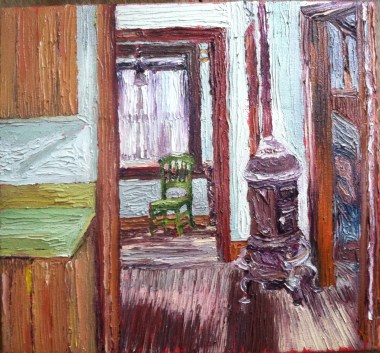
Green Chair, Stove, Counter, Thresholds.
scene from the kitchen table
12″ x 15 ” oil and palette knife
second week of May 2014
With Thanks to katie Kreutchmer.
“When we are engaged in blind compassion, we rarely show any anger, for we not only believe that compassion has to be gentle, but we also are frightened of upsetting anyone, especially to the point of their confronting us. This is reinforced by our judgment of anger, especially in its more fiery forms, as something less than spiritual; something to be equated with ill will, hostility, and aggression; something that should not be there if we were being truly loving.
In blind compassion we don’t know how to — or won’t learn how to — say “no” with any real power, avoiding confrontation at all costs and, as a result, enabling unhealthy patterns to continue. Our “yes” is then anemic and impotent, devoid of the impact it could have if we were also able to access a clear, strong “no” that emanated from our core.
When we mute our essential voice, our openness is reduced to a permissive gap, an undiscerning embrace, a poorly boundaried receptivity, all of which indicate a lack of compassion for ourselves (in that we don’t adequately protect ourselves). Blind compassion confuses anger with aggression, forcefulness with violence, judgment with condemnation, exaggerated tolerance with caring, and spiritual correctness with moral maturity.”
-R.a.m.
p. 303-304 of “The Culture of Make Believe”
“Don’t. Don’t look. Don’t listen. Don’t love. Don’t let the other be. Don’t. The best way to gaurantee you won’t be in relationship with something is to not see it. The best way to make certain you won’t see something is to destroy it. And completing this awful circle, it is easiest to destroy something you refuse to see. This in a nutshell, is the key to our civilisation’s ability to work its will on the world and on other cultures: Our power (individually and socially) derives from our steadfast refusal to enter into meaningful and mutual relationships.
This refusal — this key to power — was carried forward and used by slavers, Columbus, Pilgrims, the Founding Fathers, Hitler. It is put forward today by politicians who send soldiers to kill at a distance, and by soldiers who do the killing. It is pushed by CEO’s and ohers who wish to reap the benefits of our economic system, and by purveyors of porn who tell us it’s OK to represent women as objects to be “fucked in every hole” (or, judging by my Alta Vista search and the prevalent statistics, to be raped) but fail to mention any form of relationship at all. It is okay, we are told incessantly (for incessant repetition is necessary to make this painful and eventually numbing lesson stick) to utilize resources, whether the resources are trees, fish, gold, diamonds, land, labor, warm, wet vaginas, or oil. Bu one must never enter into relationship with this other who owns or who is a resource. To do so would be to break the covenant with your God, whose name is Jealous, whose name is Power, because our power comes directly from your unwillingness (or, perhaps, in time, your inability) to maintain relationship: it is much easier to expl0it someone you do not consider a living being — a You, as Buber would have put it — much less a friend, a lover, a member of your family. This is the key to understanding the difference beween indigenous and civilized warfare: Even in warfare the indigenous maintain relationships wih their honored enemy. This is the key to understanding the difference between indigenous and civilized ways of living. THi sis only one of many things those we enslave could tell us, if only we asked: They, too, are alive, and present another way of living, a way of living that is not — in conradistinction to our God and our science and our capitalism and everything else in our lives — jealous. It is an inclusive way of living. THey could tell us that things don’t have to be the way they are. “






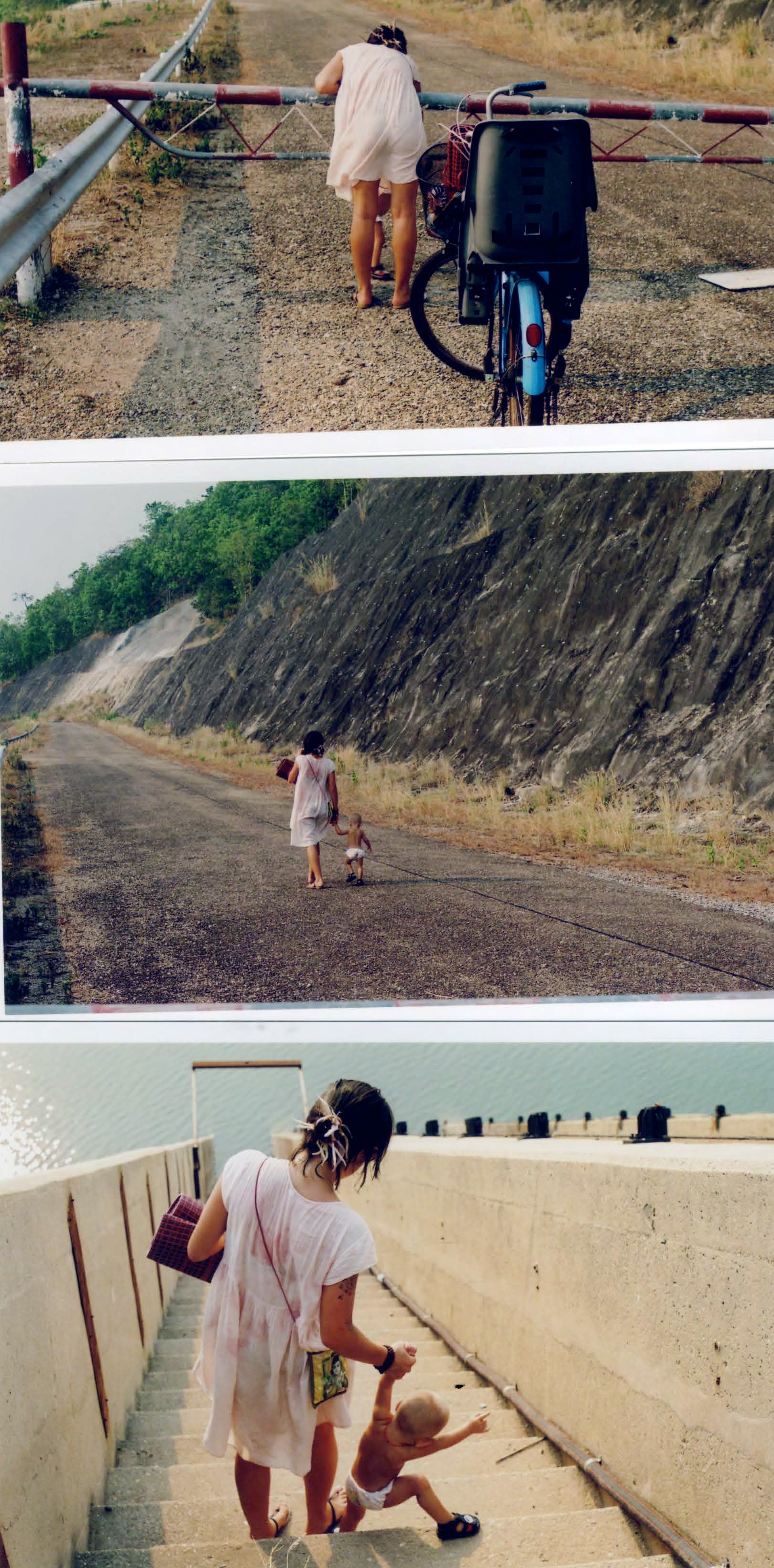


 True Blue Island