
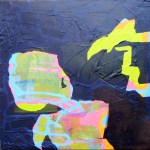
Underpainting 7/09

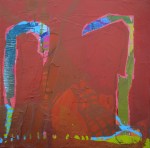
Underpainting 7/09
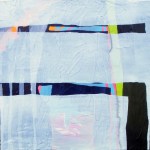
Underpainting 7/09

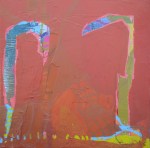
Underpainting 7/09
Underpainting 7/09
Underpainting 7/09
Archive of Jessica Townes George
Underpainting 7/09
Underpainting 7/09
Underpainting 7/09
Underpainting 7/09
Underpainting 7/09
Underpainting 7/09

“A Travel Log”
we shared a mango
while the sun appeared
an object to touch
and one
for Martha’s store
with the german shepard
guarding the door
(Later, Martha filling pitchers with water)
and Carolyn in her orchard
a bounty of children
eating quiche
between
ecclesiastical bluffs
the supreme public vista
harborview
a private view
three floors up
a rusty escape
we guess in the dark
and teeter in the day
glasses
since she was 11
seeing magnified
and always looking
dressed for Walters
we climbed under the table
to sing-a-long
the black pearl
from stern to bow
the deck
the dock
sail tags clanking on aluminum masts
even with the water
and the dark hiding everything else
to jump in
to be submerged
as if there were no edge
John Pawtucket drawing sails
a very young captain
saying how he cared
and the heart is whole again
patched
Good shot my lady
Lady Albion slinking under the moon
at dawn
planes come and go
by radio
a trip achieved
with only certain specifications
and without a sailor’s precision
but
sailors follow the wind
and so do islands
chart the summer sky
where MaryAnne
at Mansion beach
guarding the plovers
sewed buttons on a curtain
Jess and Wild Bill stayed in the sand
the sun coloring them
talking
I, under my
hat,
swam.
Dear All,
I have been meaning to write sooner. This rain has me pent up reading more of late and thinking about things i need to put on paper. Cole and i have been restless in the rain; thinking about sailing, motoring, rowing, moving around the ocean and how to create the reality we want before reality creates us. Block Island keeps calling as we need to bring work there and visit friends. It’s impossible to plan between our upcoming residency, the boys, Art Walks, teaching an alternative processing class at SMCC, and getting in the studio. Somehow the work will get to BI, but i don’t know if we will actually get a good visit in. Nova Scotia is coming quickly and we are excited to see a place we have never been before. Our curiosity with places and responding to a new landscape will surely spurn some ideas that have yet to be born.
The book i am reading, Diet for a Small Planet, has taken over the Judaic Mysticism book i am halfway through and need to return to Leon. Everything i read these days reminds me of the challenge in making work that promotes a certain spritual/political/personal platform. The idea of having mutually exclusive, and curiously well developed, private and public lives seems to be of utmost import. As my social circle expands here in Portland and i begin to feel the warmth of community after two years on Peaks, it is hard to ignore the undeniable strength in collaboration, in having collaborators.
The question then becomes how to turn valued relationships and collaborations into a means of promoting a sustainable art practice, life and family. Sacrificing one for another seems dramatic and unnecessary at this point in time, especially when we live in a country so full of choices. I am in search of life that empowers other lives, including my own on all scales. Knowingly, this requires collaborating with people who understand. Understand in a way that promotes expansion and vitality. People who understand their own and other’s pursuit of personal interests are not an indulgence of selfishness, but rather a celebration of diversity and a gathering of multiple perspectives leading to a greater understanding of all.
Two Letters
I
A letter fromEven if there had been a crescent moon
On every cloud-tip over the heavens,
Drenching the evening with crystals’ light,One would have wanted more-more-more-
Some true interior to which to return
A home against one’s self, a darknessAn ease in which to live a moment’s life,
The moment of life’s love and fortune,
Free from everything else, free above all from thought.It would have been like lighting a candle,
Like leaning on the table, shading one’s eyes,
And hearing a tale one wanted intensely to hear,As if we were all seated together again
And one of us spoke and all of us believed
What we heard and the light, though little, was enough.II
A Letter ToShe wanted a holiday
With someone to speak her dulcied native tongue,In the shadows of the wood…
Shadows, woods… and the two of them in speech,In a secrecy of words
Opened out within a secrecy of place,Not having to do with love.
A land would hold her in its arms that dayOr something much like a land.
The circle would no longer be broken but closed.The miles of distance away
From everything would end. It would all meet.

Nearby, Tim sat and shivered.

Cole was looking to gather the last of the light.
“Be these things as they may, in Snyder’s work what some of his critics may deem romanticism is balanced by an evident devotion to facts, appreciation of human practicality and capability, expressions of joy found in physical work, interest in science, and continual rumination on responsibility.” Wikipedia – Gary Snyder
Poetry is becoming that much more undeniable in my practice. Through paint and words i search for an understanding — not an answer to a question — a down to earth record of commentary on my place in the world. Perhaps, this is an effort to distinguish my existence or a hope to not fade away quickly in the future. However, it is an impulse i have to record my responses and feelings to places and people. The connection established is re-affirmed in my studio and as time passes by.
Romanticizing or having my work labeled as sentimental is a by-product of focusing on the mannerisms of my subject matter. Gary Snyder is a fine example of a poet who was also cornered (or cornered himself) into a place where this kind of commentary had the tendency to stick to his work. I noted this small part of Snyder’s Wikipedia article as a reminder that sentimentality is simply one part of a larger, more complex feeling when coming to this type of work. In turn, i feel my romantic ideas of place — the place i am in, Peaks Island, islands in general — display a similar entaglement of the joys: wandering and losing your way; appreciation of individual and collective response-ability; the record of blazed trails and gestures devised in effort move through the world; and an interest in questions of direction and divining answers.
Snyder’s work in theories of bioregionalism brings another noteworthy element of his practice into relation with my own. One of the core values of bioregionalism is to dilineate human areas based on the diverse nature of flora, fauna, and georgraphy that create boundried regions based on the organic construction and play between local ecologies. This is different than dividing people based on political maps or city limits etc. The more diverse a locale, the more resilient the ecosystem is to provide for those that dwell in that place over a long period of time.
Diverse techniques used in execution of my observation and response to a place are exampled in my practice — and collaborations with others — to become a bioregional metaphor. Admiring the bioregionalist theory and their specific analysis of place leads me to recognize the similar desire both of our practices have for exalting the diversification of one locale. How this emerges in my work is in the multiple responses i conjure from one local area. Paintings, drawings, photographs, interviews, poems, kits, etc. Each individual creative path loops back in between other paths and creates a tangled way of understanding. This way, this web — this structure — becomes an ecology on its own terms, a practice ever changing, growing, persevering, adapting, and dieing.
WHAT DO I STAND TO LOSE WHEN I EXTRACT MYSELF FROM LOCATING DEVICES?
Ditching certain locating devices, like the closed system operations of GPS or Map Quest or my cell phone i begin to loose my efficiency to operate. The quickness with which i can move through time. I lose sight of an end goal and allow all possible locations near and far to be my end point. I lose my accuracy, i may use all my sensibilities in attempt to foresee my end point but human error weighs on my senses. I become easily lost. But if efficiency, accuracy and and end are not my goals, then i embrace a journey of peaceful meanderings; being affected, wondering, and growing, at all i encounter.
WHAT DO WE GAIN/LOSE IN ENTANGLEMENTS WITH CERTAIN TECHNOLOGIES?
Specifically in using locating devices:
We gain efficiency, directness, facileness, rapidity of motion, time, and accuracy. What we lose are awareness of place; observation or evidence recorded of the journey (moving too fast to stop and do this); A loss of heightened sensations (only noticed when one is moving slowly and takes their time); the injection of the unknown which may help us discover new modes of efficiently moving on our own; We lose confidence in our innate senses and and overall loss of self reliance.
In other words we gain speed and accuracy but loose a larger sense of place and self. By plugging into a thing that is not a part of ourselves, we are allowing something that can be turned on or off to direct our movements. We are pressured to come to an end, to get there quickly and succinctly. This is different than honing our own internal sense of direction, from wandering around gathering information until we find our own way. Being directed or dominated by something outside of ourselves has benefits yet at the cost of loosing our personal internal sensibilities.
Sometimes attempting to understand stops one dead in their tracks. It initiates a paralyzing and cyclical thought process that must be injected with considerations from the outside. It is where this impulse to understand hits you, the place that gives one the ability to stand outside in order to see inside more clearly that is of interest to me. I believe it is in becoming connected to the shifting features and patterns of this place that one can better attempt to understand the features and patterns of new understandings. It is the intimate expression that emerges in between these physical and cognitive spaces that shine light on the significance of life.
It is from this new unknown, translated, enhanced, and exotic reality that depicts features of the landscape, which we must now draw meaning from to understand the painting and ourselves. It is through an intimate, non-objective process between painting and painter / painting and viewer that a response-ability and reciprocity within nature emerges and from which understanding may follow.
Dreamings – Jukurrpa– are an integral aspect of life in Central Desert society. Stories told for more than 40 000 years, Dreamings not only speak about the landscape and its vicissitudes, they create spacetimes of experience. This creative alchemy sustains not only a reciprocal relationship to the land, it is also an enactment of the Law. Law creates-with life, setting operational constraints for the perpetuation of the creative nexus between Dreaming and life. As story, Dreaming evokes the lived landscape, a spiritual and lived experience. To dream is to take response-ability seriously. It is to operate at the threshold where culture and law overlap, where the future-pastness of experiences in the making take hold.
For Aborigines, life is Dreaming in the sense that the coordinates of spacetime out of which everyday lives emerge are significantly in line with creation and recreation of the land and its Laws. But even this is too simple: the land is not an extension of the Aborigines – it is them. To be the land is to become in relation to it, in relation not to space itself, but to the living coordinates of a topological relationscape that embodies as much the Law as it does the grains of sand that prolong it in realtime. The land and the Law are not two, are not juxtaposed. They are not sustained in a present-future symbolism. They are one: a becoming multiplicity.
The Dreaming alters all dimensions of experience even as it embeds pastness in futurity. To simply locate a Dreaming as a story of creation is to touch only one aspect of the concept. Dreamings are mythological and cosmogenic tales that are not simply stories of creation (with all attendant dramas and misunderstandings, love stories and disappointments) in the Biblical sense, they are also stories of the creation of the future-present. Dreamings do not exist once and for all (although they also do that): they are tales for the retelling through song, voice, dance, paint. Dreams are for keeping alive.
The cosmology of the Dreaming must be understood as both actual and virtual. It is as an overlapping of the two, where reality and dream are not opposed but superimposed. Aborigines of the Central Desert animate time in space. In their rituals, the present is ancestralised not as a nostalgia for the past but as a becoming-future. The past and future, the actual and the virtual are traces of becoming whose dimensions are experienced in shifting continuity as through the spiral of a Nietzschean eternal recurrence. When time is activated in this way what emerges is a time-line that is not linear. The present is always in the mode of an embodying withness not of a forgotten past but of a reexperiencing in the future-present.
To experience Alhalkere is to feel the recomposition of a living landscape that is not separate from the perception of perception that recomposes us. Alhalkere is the Dreaming insofar as it incurs concern for the event that is the shapeshifting of experience. Moving-with its own eventful becoming, Alhalkere becomes a metastable system that cannot be thought outside the experiential field it opens. Touching (with) us, Alhalkere asks that we have concern for the Dreaming.
It is to take the immanent materiality of the Dreamings seriously and to note that what paintings such as Alhalkere do exceeds the parameters of their landmarks. Their concern is for the embodied eventness of land, not a pre-determined location.
The relation the Dreaming proposes is not composed separately from its eventness. Dreamings are here and now as much as they are then and before. Dreamings are neither nostalgic nor predictable. They are concern for the present passing.
A Dreaming is not an entity, not a place. It is a movement, a song and a dance, a practice of mark-making that does not represent a spacetime but creates it, again and again.
Timespace is at the heart of this complex art as are conceptual slidings, performative experience, rituals of appearance and disappearance. This timespace is not haphazard: Dreamings must be performed lest they disappear into disuse, their songs forgotten or unsung.
Topology refers to a continuity of transformation that alters the figure, bringing to the fore not the coordinates of form but the experience of it. Topologies suggest that the space of the body extends beyond Euclidean coordinates to an embodiment of folding spacetimes of experience: pure plastic rhythm.
Topological spacetime refutes the dichotomy between the abstract and the concrete. Topological spacetime is not 1 + 1 but n + 1, always more-than. The Dreaming is an evocation of such a topological spacetime of experience. It situates land, body, space, time, experience all in one structural node, an elastic point that fields the perpetual movement of time.
To think topologically is to think dynamically: it is to situate the movement of thought at its transformational vector, deforming it into its potential. When we re-render the form static, when we stop the process, we are shortchanging the experience.
The desert is not one space: it is many overlapping spacetimes of experience that Aboriginals call Dreamings. These Dreamings can be drawn into maps, but such maps will never lead us anywhere if we expect them to do the walking for us.
. Space here is performed, folding into durations that become part of the materiality of the painterly event.
Bringing futurity into the mix, the sixth panel seems to virtually contain all the other canvases, holding the series together even while exhausting it, the paintbrush squeezing out its last drops of colour. In Whiteheadian terms, the subjective form has coalesced (concresced). It is the event that composes the series even as it marks the beginning of its perishing.
where “the world within experience is identical with the world beyond experience, the occasion of experience is within the world and the world is within the occasion” (Whitehead 1933: 228).
). Percepts are “independent of a state of those who undergo them” and affects do not arise from subjects but pass through them (Deleuze and Guattari 1994: 169).
Emily Kngwarreye’s art moves the body through the interpellation of increasingly complex sensations that are connected not to one final event but to the perpetuation of events alive in the “whole.”
When movement is no longer indexed to position (when mapping becomes an event), position itself becomes mobile.
the figure is the movement of becoming itself.
Gilles Deleuze suggests that the figure need not be conceived as the figurative. For a more detailed explanation, see his work on Bacon in Logic of Sensation (Minneapolis:Minnesota UP, 2003).
It is the rhythm of the land I see in Kngwarreye’s relationscapes, a rhythm that refuses to subjugate the image to the text, the dance to the music. The rhythm is all around, it is the “whole lot”: the weather, the seasons, the births and deaths, the rituals and performances, the body painting and batiks. These rhythms are sensations of the boldest kind, sensations that alter the very core of what it is to sense. There is no inside/outside to the sensations: they are as much of the body as of the land, extending synesthetically beyond all comprehension of three-dimensional spacetime, leading us not toward a dimension as such but toward a topological hyperspace of relationscapes, to an immanent transcendence that is profoundly of the land, of the here and now. [insert image 59 – Kngwarreye Merne Kame 1995]
The observations marked in my paintings are possibly valid for other people. Though I can not make claims for more than the life i observe on this island and my practice which sustains my dreamings.
QUESTIONS:
Direction. non-euclidian non x-y axis. how to describe the direction of dreams and how to map them? how to not map them but track their mobility?
-ice skater/figure 8 = the type of figure that my painting is expressing. read Deleuze on Bacon.
-Interplay between backround/foreground (folding in)
-Painting experience in the making
-Do people need to understand topologies in coming to my work?
-Paintings of experience, spacetimes, the activity of making
-The law( processional rules)(series of events and things coming one after another) is created to perpetuate dreaming and life. Its constraints coral the meeting of both.
-subjective form has coalesced. Coalescing is the event which marks the making and the beginning of the events destruction. The subject is the movement of the figure becoming itself.
He took the words right out of my mouth!
60.
I enrolled in a class in mushroom identification.
The teacher was a Ph.D. and the editor of a
publication on mycology. One day he picked up a
mushroom, gave a good deal of information about it,
mainly historical, and finally named the plant as
Pluteus cervinus, edible. I was certain that that
plant was not Pluteus cervinus. Due to the
attachment of its gills to the stem, it seemed to
me to be an Entoloma, and therefore possibly
seriously poisonous. I thought: What shall I do?
Point out the teacher’s error? Or, following school
etiquette, saying nothing, let other members of the
class possibly poison themselves? I decided to
speak. I said, “I doubt whether that mushroom is
Pluteus cervinus. I think it’s an Entoloma.” The
teacher said, “Well, we’ll key it out.” This was
done, and it turned out I was right. The plant was
Entoloma grayanum, a poisonous mushroom. The teacher
came over to me and said, “If you know so much about
mushrooms, why do you take this class?” I said, “I
take this class because there’s so much about
mushrooms I don’t know.” Then I said, “By the way,
how is it that you didn’t recognize that plant?” He
said, “Well, I specialize in the jelly fungi; I just
give the fleshy fungi a whirl.”
the purpose of purposelessness.
one of the most interesting parts of this lecture is the other noises that enter into listening to the sounds of cage’s voice and composition. Allen in his studio tap tap tapping, kids talking nearby, fish tank filtering water, bird chirping outside, running water, pots clanging in the kitchen etc…


 True Blue Island