


Archive of Jessica Townes George
” This problem sucks / why would you go make a problem like that / this teacher is evil. ”
These words taken out of the context of a math student working on their take home test and replaced into a scenario of a interpersonal human dynamic makes me stop, linger on the expression, remain silent and smile.
Problems are problems, and the reactions are so much more objective when we are speaking of math. People who shed light on an opportunity for a problem to be solved, who create problems, who propose that there is a problem to be solved, who give it to someone else, could be viewed as a teacher. They also may be a friend, a lover, a hinderance, a challenger, a stranger etc. Mostly, they are an obstacle to ourselves. An obstacle in coming to terms, identifying the variables and stabilizing a playing field. We problem solve in order to move through the world, in order to pass tests.
It is in moving from one state to another that my brain nearly explodes with necessity to solve (non-mathematical) problems. The major problem i have is my inability to pinpoint a desired goal. I am of the philosophy that where you are is where you should be and therefore, steps taken to get somewhere else are loosely premeditated but small in measure. I also despise measuring things (except for in those cases when you have to move something heavy and are uncertain if it will fit where you are going and you don’t want to lug it just to find out its going to be awkward in another space. so, in that case, i think you should measure to know what to leave behind before you move that thing to fit in (unless you want it to stick out)) but sometimes you don’t even know the size of the next space so, again, its useless to measure! any incremental advancements are mostly of un-notable mention. Seems that a good chunk of time spent always gets you somewhere though because you get to have a good idea of what the shape and size of your space and things are, and they can be re-arranged according to changing moods. Adding is complicated though, however, direct. Multiplying is less direct but adds dimension, Dividing is painful, subtraction can lead to negative valence.
Things can not always be solved in a short time frame, and having a good chunk of time available at the beginning of a problem gives way to less time the more you work on it, unless you prioritize it. The problem must be imperative. Sometimes we forget to give emotional problems priority and forget about closure. Other times emotions overwhelm our brainpower to come to closure as they do not let us think clearly! Still at other times, non emotional problems become emotional problems simply by remaining unsolved!
All and all, problems are problems and they feel good to solve. my own inability to identify goals is the number one problem in my own problem solving methods. Purposelessness seems valuable in some right, maybe it is just a place holder. My sense of purpose does correspond with my dreams and desires, and i shall focus on them, find or create consistency, and quiet my doubtful insides. Plus, in addition to, i found The Foxfire Book – hog dressing, log cabin building, mountain crafts and foods, planting by the signs, snake lore, hunting tales, faith healing, moonshining, and other affairs of plain living in the Franklin Library. For now, problem solved.
BUIRNT NORTON (No. 1 of ‘Four Quartets’) T.S. Eliot
I
Time present and time past Are both perhaps present in time future, And time future contained in time past. If all time is eternally present All time is unredeemable. What might have been is an abstraction Remaining a perpetual possibility Only in a world of speculation. What might have been and what has been Point to one end, which is always present. Footfalls echo in the memory Down the passage which we did not take Towards the door we never opened Into the rose-garden. My words echo Thus, in your mind. But to what purpose Disturbing the dust on a bowl of rose-leaves I do not know. Other echoes Inhabit the garden. Shall we follow? Quick, said the bird, find them, find them, Round the corner. Through the first gate, Into our first world, shall we follow The deception of the thrush? Into our first world. There they were, dignified, invisible, Moving without pressure, over the dead leaves, In the autumn heat, through the vibrant air, And the bird called, in response to The unheard music hidden in the shrubbery, And the unseen eyebeam crossed, for the roses Had the look of flowers that are looked at. There they were as our guests, accepted and accepting. So we moved, and they, in a formal pattern, Along the empty alley, into the box circle, To look down into the drained pool. Dry the pool, dry concrete, brown edged, And the pool was filled with water out of sunlight, And the lotos rose, quietly, quietly, The surface glittered out of heart of light, And they were behind us, reflected in the pool. Then a cloud passed, and the pool was empty. Go, said the bird, for the leaves were full of children, Hidden excitedly, containing laughter. Go, go, go, said the bird: human kind Cannot bear very much reality. Time past and time future What might have been and what has been Point to one end, which is always present.
II
Garlic and sapphires in the mud Clot the bedded axle-tree. The trilling wire in the blood Sings below inveterate scars Appeasing long forgotten wars. The dance along the artery The circulation of the lymph Are figured in the drift of stars Ascend to summer in the tree We move above the moving tree In light upon the figured leaf And hear upon the sodden floor wBelo, the boarhound and the boar Pursue their pattern as before But reconciled among the stars.
At the still point of the turning world. Neither flesh nor fleshless; Neither from nor towards; at the still point, there the dance is, But neither arrest nor movement. And do not call it fixity, Where past and future are gathered. Neither movement from nor towards, Neither ascent nor decline. Except for the point, the still point, There would be no dance, and there is only the dance. I can only say, there we have been: but I cannot say where. And I cannot say, how long, for that is to place it in time. The inner freedom from the practical desire, The release from action and suffering, release from the inner And the outer compulsion, yet surrounded By a grace of sense, a white light still and moving, Erhebung without motion, concentration Without elimination, both a new world And the old made explicit, understood In the completion of its partial ecstasy, The resolution of its partial horror. Yet the enchantment of past and future Woven in the weakness of the changing body, Protects mankind from heaven and damnation Which flesh cannot endure. Time past and time future Allow but a little consciousness. To be conscious is not to be in time But only in time can the moment in the rose-garden, The moment in the arbour where the rain beat, The moment in the draughty church at smokefall Be remembered; involved with past and future. Only through time time is conquered.
III
Here is a place of disaffection Time before and time after In a dim light: neither daylight Investing form with lucid stillness Turning shadow into transient beauty With slow rotation suggesting permanence Nor darkness to purify the soul Emptying the sensual with deprivation Cleansing affection from the temporal. Neither plenitude nor vacancy. Only a flicker Over the strained time-ridden faces Distracted from distraction by distraction Filled with fancies and empty of meaning Tumid apathy with no concentration Men and bits of paper, whirled by the cold wind That blows before and after time, Wind in and out of unwholesome lungs Time before and time after. Eructation of unhealthy souls Into the faded air, the torpid Driven on the wind that sweeps the gloomy hills of London, Hampstead and Clerkenwell, Campden and Putney, Highgate, Primrose and Ludgate. Not here Not here the darkness, in this twittering world.
Descend lower, descend only Into the world of perpetual solitude, World not world, but that which is not world, Internal darkness, deprivation And destitution of all property, Desiccation of the world of sense, Evacuation of the world of fancy, Inoperancy of the world of spirit; This is the one way, and the other Is the same, not in movement But abstention from movement; while the world moves In appetency, on its metalled ways Of time past and time future.
IV
Time and the bell have buried the day, The black cloud carries the sun away. Will the sunflower turn to us, will the clematis Stray down, bend to us; tendril and spray Clutch and cling?
Chill Fingers of yew be curled Down on us? After the kingfisher’s wing Has answered light to light, and is silent, the light is still At the still point of the turning world.
V
Words move, music moves Only in time; but that which is only living Can only die. Words, after speech, reach Into the silence. Only by the form, the pattern, Can words or music reach The stillness, as a Chinese jar still Moves perpetually in its stillness. Not the stillness of the violin, while the note lasts, Not that only, but the co-existence, Or say that the end precedes the beginning, And the end and the beginning were always there Before the beginning and after the end. And all is always now. Words strain, Crack and sometimes break, under the burden, Under the tension, slip, slide, perish, Decay with imprecision, will not stay in place, Will not stay still. Shrieking voices Scolding, mocking, or merely chattering, Always assail them. The Word in the desert Is most attacked by voices of temptation, The crying shadow in the funeral dance, The loud lament of the disconsolate chimera.
The detail of the pattern is movement, As in the figure of the ten stairs. Desire itself is movement Not in itself desirable; Love is itself unmoving, Only the cause and end of movement, Timeless, and undesiring Except in the aspect of time Caught in the form of limitation Between un-being and being. Sudden in a shaft of sunlight Even while the dust moves There rises the hidden laughter Of children in the foliage Quick now, here, now, always— Ridiculous the waste sad time Stretching before and after.

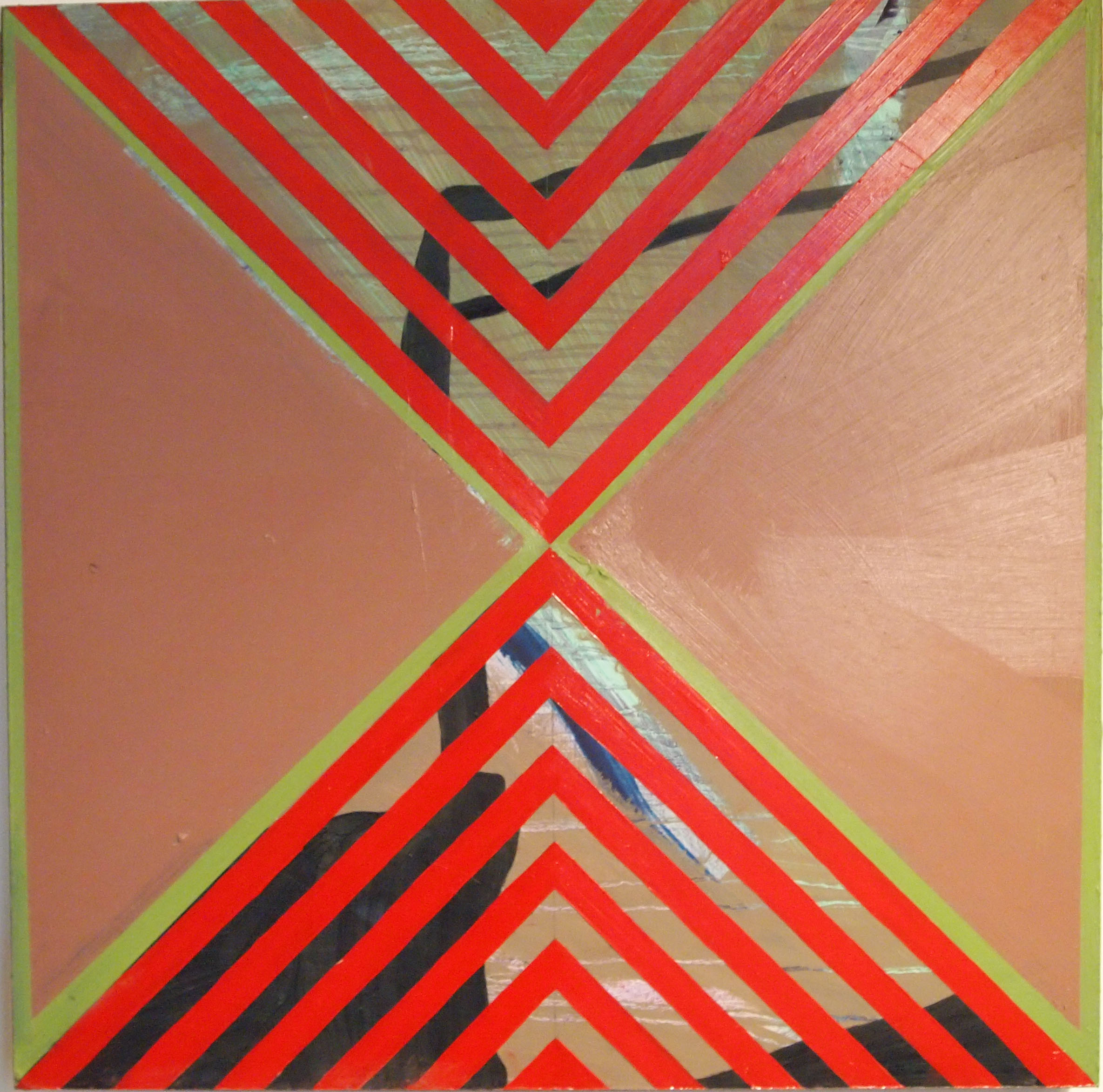
 Painting is a technology that facilitates belief. It functions as a processing device to propagate visions. It uses visual language to validate an occurrence. When the occurrence is translated into such a format, it offers the viewer and painter — through the making and the viewing — an opportunity to leave such visions, such recorded occurrences, where they lie.
The act of painting keeps [past, impermanent, mortal] things — alive. This method of organizing thoughts through an unpacking of fluctuating everyday visuals lightens an internal storage space. It lets us return and move on from the tiresome replaying of what we once saw in order to let ourselves leave things behind and move onward with less weight.
|
|
Don’t be clever, otherwise you will remain the same, you will not change. Half-techniques on the path of love and half-techniques on the path of meditation will create much confusion in you. They will not help…. But to ask for help is against the ego, so you try to compromise. This compromise will be more dangerous, it will confuse you more because, made out of confusion, it will create more confusion. So try to understand why you hanker for compromise. Sooner or later you will be able to understand that compromise is not going to help. And compromise may be a way of not going in either direction, or it may be just a repression of your confusion. It will assert itself. Never repress anything, be clear-cut about your situation. And if you are confused, remember that you are confused. This will be the first clear-cut thing about you: that you are confused. You have started on the journey.
Osho Dang Dang Doko Dang Chapter 4
Commentary:
In the courts of ancient Japan, the male attendants were often selected from the ranks of petty criminals who were castrated. Because of their intimate familiarity with the activities of the court, they were often at the center of the political and social intrigues and exercised a great deal of power behind the scenes. The two figures on this card remind us of the sleazy and conspiratorial situations we can get into when we compromise our own truth. It is one thing to meet another halfway, to understand a point of view different from our own and work towards a harmony of the opposing forces. It is quite another to “cave in” and betray our own truth. If we look deeply into it, we usually find that we are trying to gain something–whether it is power or the approval of others. If you are tempted, beware: the rewards of this kind of compromise always leave a bitter taste in the mouth.
Jouissance
Description
Jouissance, in French, means enjoyment and pleasure, in particularly in an over-the-top sense. It contrasts with ‘plaisir’, which is a controlled state that happens within cultural norms.
Jouissance is pleasure (and any stimulation) that can be too much to bear. It may be very largely felt as suffering. It is pleasure and pain together, a feeling of being at the edge.
It can indicate a breaking of boundaries, a connection beyond the self. This can range from a mother feeling intense connection with a breast-feeding baby to meditative feelings of oneness with the universe.
One of the goals of life is to manage jouissance. Unchecked emotion will control and overwhelm you. Society helps this through controlling mechanisms such as education and cultural norms. It has been said that jouissance is ‘drained’ from the body throughout life, leading to the calm of old age.
Discussion
In French, jouissance connotes orgasm as well as pleasure, and can be used to describe breaking down barriers between self and other. It may also be used to indicate orgasm that is not achieved or not ‘ultimate’, thus bringing a sense of lack, loss and something unattainable.
Lacan argues that the subject, separated from itself by language, feels a sense of absence, of being not fully present, and thus desires wholeness. We constantly put ourselves into the subject positions of language and cultural codes in seeking to fulfil the futile desire for wholeness. We feel jouissance as the pleasure/pain that the subject feels as it tries in vain to recapture the lost object.
Jacqueline Rose uses jouissance in description of women’s management of identity. In the phallic economy, the woman, who lacks the phallus, stands in the place of jouissance and the lost object and is thus becomes both desirable and ultimately unobtainable. This gives women a separate position from which they can ‘speak themselves’ and resist subjugation.
As post-Oedipal girls can sustain a closer relationship with their mother, they are consequently able to sustain a greater level of jouissance. This is something that boys envy and seek through dominance and possession of girls.
A significant part of the game of romance is in chasing jouissance. Although it can never be gained, the anticipated pleasure of hope makes the pursuit a very exciting experience.
Zizek aligns by saying that psychical life is about enjoyment, but which is interwoven with lack and alienation. Enjoyment comes from escapist fantasy. It gives ideology power, creating meaning for the self within the frame of ideology. It cannot be incorporated into the symbolic.
See also
Lacan, Ideology, Mirror phase, Feminism, Desire
http://changingminds.org/disciplines/psychoanalysis/concepts/jouissance.htm





 True Blue Island