Archive for the 'Research/Extracts/Abstracts of Interest' Category

White Galactic Dog

January 17, 2011

Electric Moon day 1
Year of the White Self-Existing Wizard

kin 190: White Galactic Dog
I Harmonize in order to Love
Modeling Loyalty
I seal the Process of Heart
With the Galactic tone of Integrity
I am guided by the power of Timelessness


FIND YOURS HERE: http://www.tortuga.com/eng/decode/index.php

on the First Day of Falling in Love with a Cat (when you live with a dog)

December 8, 2010

John Berger on Tradition, Compulsion, and Outsiders

November 20, 2010

“But then one has to ask: why does he refuse the tradition? And the answer is only partly that he was born far away from that tradition.  The effort necessary to begin painting or sculpting, in the social context in which he finds himself, is so great that it could well include visiting the museums.  But it never does, at least at the beginning.  Why? Because he knows already that his own lived experience which is forcing him to make art has no place in tradition.  How does he know this with out visiting the museums? He knows it because his whole experience is one of being excluded from the exercise of power in his society, and he realises from the compulsion he now feels, that art too has a kind of power.  The will of primitives derives from faith in their own experience and a profound scepticism about society as they have found it.
I hope I have now made clearer why the “clumsiness” of primitive art is the precondition of its eloquence.  What it is saying could never be said with any ready-made skills.  For what it is saying was never meant, according to the cultural class system, to be said.”

1976
“About Looking” p. 68
John Berger

Triangle Permutations:

November 10, 2010

http://mnartists.org/work.do?rid=55383

Two Trees – Friendliness – Osho Zen Card no.2

September 8, 2010

http://www.osho.com/Main.cfm?Area=Magazine&Sub1Menu=Tarot&Sub2Menu=OshoZenTarot&Language=English

First meditate, be blissful, then much love will happen of its own accord. Then being with others is beautiful and being alone is also beautiful. Then it is simple, too. You don’t depend on others and you don’t make others dependent on you. Then it is always a friendship, a friendliness. It never becomes a relationship, it is always a relatedness. You relate, but you don’t create a marriage. Marriage is out of fear, relatedness is out of love. You relate; as long as things are moving beautifully, you share. And if you see that the moment has come to depart because your paths separate at this crossroad, you say good-bye with great gratitude for all that the other has been to you, for all the joys and all the pleasures and all the beautiful moments that you have shared with the other. With no misery, with no pain, you simply separate.

Osho The White Lotus Chapter 10

Commentary:

The branches of these two flowering trees are intertwined, and their fallen petals blend together on the ground in their beautiful colors. It is as if heaven and earth are bridged by love. But they stand individually, each rooted in the soil in their own connection with the earth. In this way they represent the essence of true friends, mature, easy with each other, natural. There is no urgency about their connection, no neediness, no desire to change the other into something else. This card indicates a readiness to enter this quality of friendliness. In the passage, you may notice that you are no longer interested in all kinds of dramas and romances that other people are engaged in. It is not a loss. It is the birth of a higher, more loving quality born of the fullness of experience. It is the birth of a love that is truly unconditional, without expectations or demands.

Fire.

August 17, 2010

7.21.10 Birthday Playlist (channeled through Portland’s 98.9 wclz)

July 22, 2010

Jakob Dylan & Niko Case – Nothin But the Whole Wide World

David Gray – Sail Away With Me

Tori Amos – Crucify

Sister Hazel – Change Your Mind

Ray LaMontagne – Beg, Steal or Borrow

Matchbox Twenty – Push

Jump Little Children – Cathedrals

Collective Soul – Shine

Palace Something – Will Oldham

July 11, 2010

Well, I guess the idea is that when you have a name of a group or an artist, then you expect that the next record, if it has the same name, should be the same group of people playing on it. And I just thought we were making a different kind of record each time, with different people, and different themes, and different sounds. So I thought it was important to call it something different so that people would be aware of the differences.[2]

http://en.wikipedia.org/wiki/Palace_Music

Last October/November: Simonton Quarry Rockport, ME. cc/mh/jg

July 11, 2010

Parker’s Book

June 12, 2010

List of Photographs

1. Pigeon
2. Garden of Shrubs
3. New Ivy
4. Feather
5. Seagull
6. Human, male/female
7. Seagull – Trash eater
8. Habitat
9. Domesticated canine with human
10. Pair of Pigeons
11. Pigeons in Habitat
12. Human Activity / Surf Shop
13. Prickly Bush
14. Human Interaction
15. Transportation
16. Feet with Feather
17. Observer

Colors by Cultural Emotion

April 28, 2010

http://www.informationisbeautiful.net/visualizations/colours-in-cultures/

For Help With Nostalgia

March 22, 2010

Re-read.

I still don’t know if its better to just live with it or get over it, but in the best interest of newer objects of affection, one might consider getting over it.  Also consider what utopias may be other than fantastical unsustainable ideals.  Are they highly designed escapes?

Read again:

“Nostalgia is a sadness without an object, a sadness which creates a longing that of necessity is inauthentic because it does not take part in lived experience.  Rather, it remains behind and before that experience.  Nostalgia, like any form of narrative, is always ideological: the past it seeks has never existed except as narrative, and hence, always absent, that past continually threatens to reproduce itself as a felt lack.  Hostile to history and its invisible origins, and yet longing for an impossibly pure context of lived experience at a place of origin, nostalgia wears a distinctly utopian face, a face that turns toward a future-past, a past which has only ideological reality.  This point of desire which the nostalgic seeks is in fact the absence that is the very generating mechanism of desire.  As we shall see in our discussion of the souvenir, the realization of re-union imagined by the nostalgic is a narrative utopia that works only by virtue of its partiality, its lack of fixity and closure: nostalgia is the desire for desire.

The prevailing motif of nostalgia is the erasure of the gap between nature and culture, and hence a return to the utopia of biology and symbol united within the walled city of the maternal.  The nostalgic’s utopia is prelapsarian, a genesis where lived and mediated experience are one, where authenticity and transcendence are both present and everywhere.  The crisis of the sign, emerging between signifier and signified, between the material nature of the former and the abstract and historical nature of the latter, as well as within the mediated reality between written and spoken language, is denied by the nostalgic’s utopia, a utopia where authenticity suffuses both word and world.  The nostalgic dreams of a moment before knowledge and self consciousness that itself lives on only in the self-consciousness of the nostalgic narrative. Nostalgia is the repetition that mourns the inauthenticity of all repetition and denies the repetition’s capacity to form identity.  Thus we find that the disjunctions of temporality traced here create the space for nostalgia’s eruption.  The inability of the sign to “capture” its signified, of narrative to be one with tits object, and of the genres of mechanical reproduction to approximate the time of face-to-face communication leads to a generalized desire for origin, for nature, and for unmediated experience that is at work in nostalgic longing.  Memory, at once impoverished and enriched, presents itself as a device for measurement, the “ruler” of narrative.  Thus near-sightedness and far-sightedness emerge as metaphors for understanding, and they will be of increasing importance as this essay proceeds.”  p.23-24 Susan Stewart – On Longing

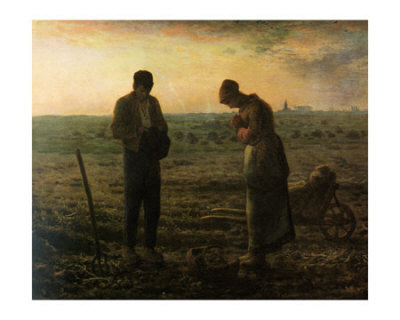
Millet – The Angelus

January 27, 2010

Rob brought up this painting last night before we all went out to see Darien Brahms play at Port City Music Hall. (She played Green Valentine for Cole)! We barely talked about the subject matter: Man and woman in a field, bent over, revering a basket. We mostly talked about how it was painted and why? Why?! Rob was interested in our thoughts on what could inform a painter to paint a particular way.  In this example with smooth, sharp, realistic execution, joined to a broken up, disparate, playful display of woven color. I am predisposed to the latter disparate way of making marks, a way of showing the world as being anything other than smooth, yet still fluid. So i quickly reacted to the replication in Rob’s art history book as beholden of valid ways of seeing the world with your own eyes.

I imagine the bottom and sides of the painting to be executed differently from the center and top because of our own eyes inability to focus on the periphery. The sharpness falls on our focus, our subject, the people we are looking at. The surrounding areas inevitably fall off and are recreated in pieces because they are not the focus of light or of our vision, but are still being molded into appearing by the light. I went all the way to say that painting something in a situation that is more direct to the actual light source depicted in your painting makes it a better painting. I know, i say things like this in very limited company, and then write down the word “better” here. Don’t know if i really want to say that, but lets just put it our there, and now talk about what Rob brought this painting to our attention for.

Rob and Cole had talked about the piece briefly before, they noted The Angelus as being a painted work displaying evidence of strong influences of photography. Cole agreed with Rob that Millet was depicting a vision that was not seen before photography. They thought that the way the periphery is painted — blurry, broken up, less focused — is indicative of a camera’s ability to re-present the world. In other words, the camera begins to show things as somewhat vignetted as a lens is rounded. They speculated that Millet surely looked into a camera obscura and had access to the technologies of the day which could re-present a scene in this way. No one spoke of the painting being made FROM a photograph, simply that it had the potential to have been INFLUENCED by a photograph.

The great and complicated relationship painting has to photography still eludes me in definition. Its helpful to be a part of a conversation like this. Its helpful to remember dates and times of advancement in sight. Its helpful to talk about the medium’s respective differences and also to note when we see them coming together to create a singular vision, like we presume they are in The Angelus. Recognizing when one is exposed to technologies which help us record and re-present the world help us to understand the trajectory painting has taken to get to now. Things that have never been seen before begin to show in Millet’s example of multiple ways of seeing the world. A way that shows us the beginning of a painter’s — an artist’s — ability to make a version of the world which includes multiple perspectives, not disproportional re-presentations, but more than one way of seeing in one thing.

Either way you break it down — as a personal vision or as a way of seeing perpetuated by photography — there exists an undeniable admittance that photography did exist at the moment in time this painting was made. Chronologically reassuring us that photography was accessible.   It also reminds us that painting has a strong ability to evolve and incorporate different ways of seeing the world into itself in order to connect with a viewer. An ability to take different views and impart, coerce, weave, collect, relate, multiple impressions to show a clear singular thought and vision.

New Logo: The Sphinx

January 17, 2010

Oedipus and the Sphinx - Gustave Moreau

Sitting at Ozzie’s, a coffee shop on 5th ave and Garfield in Brooklyn’s Park Slope area, i came across an astrology book printed in the 70’s, but first published in 1943.  Its writing described an aspect of astrology that i began to understand a few years ago, yet had found little other writing to support a way of thinking about the zodiac.  Simply, it is an analogy of the cycle of the development of human life (from young to old, infant to elderly)  to that of the sky’s cyclical system of rotating zodiacal signs.  The western astrological cycle does not correspond to our sense of time in years with say, January being the beginning.  Instead it begins at the end of March in Aries.  In this way of understanding the zodiac, Aries is the beginning, the infant, the blank slate, the state of wonder of the world.  Pisces (which comes right before Aries) is the end, has seen it all, tried everything and understands through experience, or from innate empathy for it encompasses what has come before.
This book at Ozzie’s, Astrological Signs – The Pulse of Life by Dane Rudhyar, illustrated a striking state of the transformation of time between Leo and Virgo.  This point in the zodiac interests me as my love, partner and collaborator, Cole Caswell is a sun in the cancer-leo cusp and i am a virgo-libra. We live together on the bridge from Leo to Virgo.  Here Rudhyar describes is where:

Productive activity on the basis of strict individualism and emotional self-expression presents to man a riddle.  How can physical and nervous exhaustion, emotional tragedy and disillusionment be avoided?  In essence this is the question which man everlastingly asks of the Sphinx; and there is a fitting tradition which says that the point of the zodiac which ends the sign Leo and begins the sign Virgo carries the symbol of the Sphinx.  This mythical creature which still faces today the sands of Egypt has the body of a lion and the head of a virgin — this is indeed the meeting point of Leo and Virgo.  It symbolizes the answer to the eternal query we have just stated.  What is this answer?
The answer is two-fold; yet the two sides of it should be integrated and that integration, difficult in practice though simple in theory is the very secret of the Sphinx, which is two being in one.  One side of the answer refers to the wear and tear produced by the impulsive and stressful type of activity and its dramatic gestures.  The answer can be summed up in one word: Technique.  The other side of the picture deals with a repolarization of the emotional nature itself.  Technique and emotional repolarization are the two keys to the secret of the Sphinx.          p.70-71

I found it fitting that the symbol of the Sphinx is one that presents us with riddles and answers to the meaning of being alive.  Life, here, is composed of both animal and human parts, two perspectives Cole and I often consider in our work.  As artists, Cole and I collectively rack our brains and trudge onward wondering how to avoid and cope with “physical and nervous exhaustion, emotional tragedy and disillusionment” coming up with methods for coping and staying conscious become the crossbeams that allow our learned techniques in the visual arts to build a larger and more secure and sustainable structure where we can continue to produce work under.    With the head of the virgin and the body of a lion, i imagine an accurate representation, a well organized example of curiosity, emotion, and integration of what leo-virgos do in the time between each other.

Borrowed from The Book Collection of R.Lieber:

November 9, 2009

The Loom of Art
Germain Bazin (Chief Curator, Museum of the Louvre) – author.
Jonathan Griffin – translator.
Simon and Schuster. New York. 1962. 328p.


On Longing: Narratives of the Miniature, the Gigantic, the Souvenir, the Collection

Susan Stewart
Duke University Press. 1993. 232p.


The Poetics of Space

Gaston Bachelard
1958.